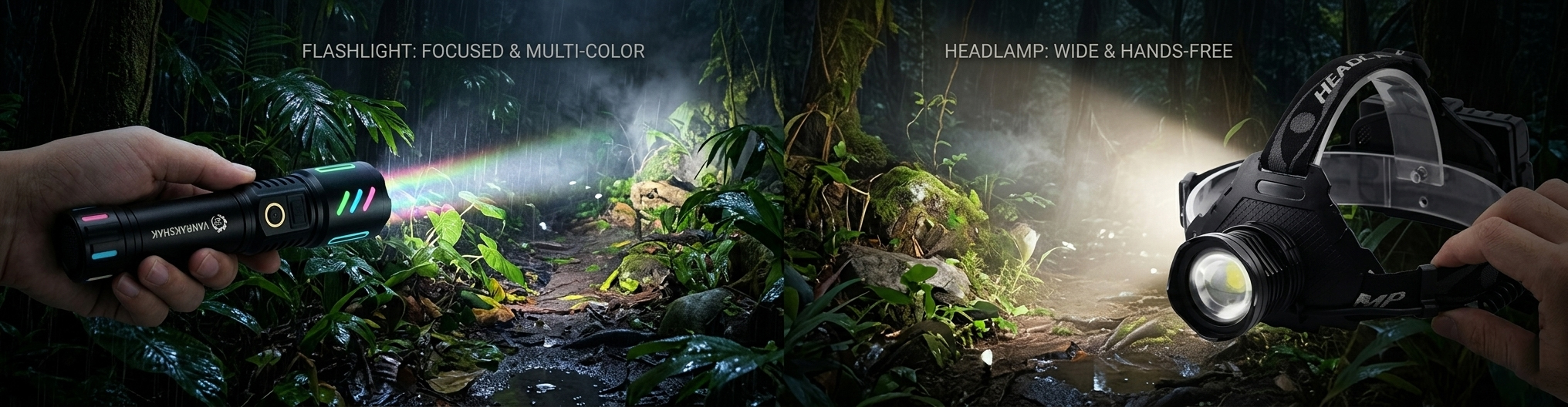
Choosing between a handheld flashlight and a headlamp usually comes down to one question: do you need your hands free, or do you need maximum control over the beam? Both have their place in a gear kit, but they excel in very different scenarios.
The Headlamp: Hands-Free Efficiency
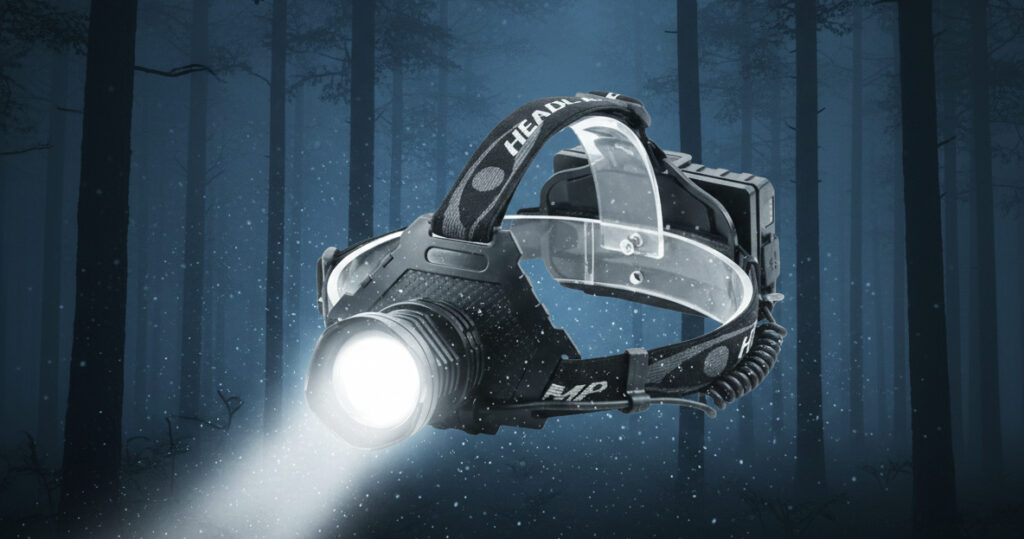
Headlamps are the gold standard for activities where your hands are busy. Whether you’re setting up a tent after dark, trekking on uneven terrain with trekking poles, or changing a tire, a headlamp ensures the light follows your gaze.
Pros
Hands-Free Operation: Essential for multitasking and safety.
Natural Light Path: The beam is always directed exactly where you are looking.
Weight Distribution: Modern headlamps are lightweight and balanced, making them comfortable for long-distance hiking or trail running.
Cons
The “Fog” Factor: Because the light source is close to your eyes, it can reflect off mist, rain, or dust, causing a “white-out” effect in your field of vision.
Lower Peak Output: Generally, headlamps have smaller batteries and heat-sinking capabilities compared to heavy-duty flashlights.
The Flashlight: Power and Precision
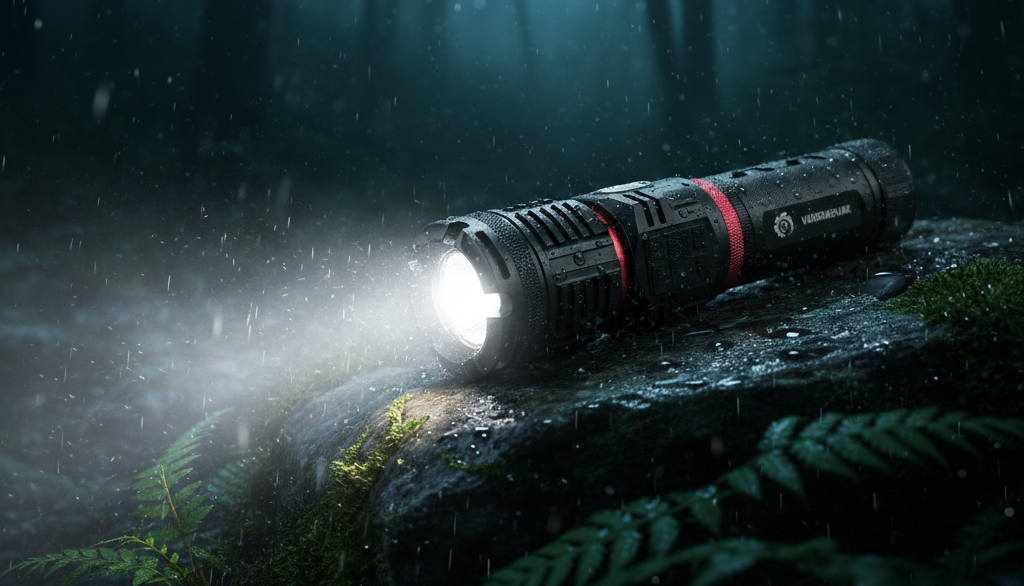
When you need to “punch” through the darkness or scan a wide area, a dedicated flashlight is hard to beat. They offer superior ergonomics for signaling and searching.
Pros
Superior Throw and Lumens: Flashlights often house larger reflectors and more powerful LEDs, allowing for a much longer beam distance.
Versatile Positioning: You can hold a flashlight at waist level to cast long shadows over the ground, making it easier to spot tripping hazards like roots or rocks.
Durability: High-end tactical or outdoor flashlights are often built with thicker aluminum housing, making them incredibly rugged.
Cons
One Hand Occupied: This can be a major drawback during technical tasks or long treks.
Hand Fatigue: Holding a light for hours during a night search can become tiring.
Comparison at a Glance
Feature
Headlamp
Flashlight
Best For
Setting up camp, running, repair work
Searching, signaling, long-range spotting
Beam Control
Follows head movement
Highly maneuverable by hand
Max Brightness
Moderate (typically 200–1000 lumens)
High (can exceed 3000+ lumens)
Ergonomics
Head-mounted, hands-free
Handheld, can be heavy
Which One Should You Choose?
Choose a Headlamp if: You are a backpacker, climber, or someone who frequently performs tasks in the dark. It is the most practical choice for general “camp life” and navigation.
Choose a Flashlight if: You are involved in search and rescue, wildlife spotting, or need a reliable self-defense tool. It’s the better choice for high-intensity illumination.
Pro Tip: In the field, redundancy is key. Many experienced outdoor enthusiasts carry a lightweight headlamp for camp tasks and a high-output flashlight for long-range navigation or emergencies.
It is a long established fact that a reader will be distracted by the readable content of a page when looking at its layout. The point of using Lorem Ipsum is that it has a more-or-less normal distribution, as opposed to using ‘Content here, content here’.
rosetyler
There are many variations of passages of Lorem Ipsum available, but the majority have suffered alteration in some form, by injected humour, or randomised words which don’t look even slightly believable.
rosetyler
The standard chunk of Lorem Ipsum used since the 1500s is reproduced below for those interested. Sections 1.10.32 and 1.10.33 from “de Finibus Bonorum et Malorum” by Cicero are also reproduced in their exact.
Ruta Vaghasiya
Many desktop publishing packages and web page editors now use Lorem Ipsum as their default model text, and a search for will uncover many web sites still in their infancy. Various versions have evolved over the years, sometimes by accident.






4 comments
Ruta Vaghasiya
It is a long established fact that a reader will be distracted by the readable content of a page when looking at its layout. The point of using Lorem Ipsum is that it has a more-or-less normal distribution, as opposed to using ‘Content here, content here’.
rosetyler
There are many variations of passages of Lorem Ipsum available, but the majority have suffered alteration in some form, by injected humour, or randomised words which don’t look even slightly believable.
rosetyler
The standard chunk of Lorem Ipsum used since the 1500s is reproduced below for those interested. Sections 1.10.32 and 1.10.33 from “de Finibus Bonorum et Malorum” by Cicero are also reproduced in their exact.
Ruta Vaghasiya
Many desktop publishing packages and web page editors now use Lorem Ipsum as their default model text, and a search for will uncover many web sites still in their infancy. Various versions have evolved over the years, sometimes by accident.