Choosing a telescope is often the first step into a much larger world. Whether you are looking to spot the rings of Saturn or peer into distant nebulae, the “right” telescope is the one that balances optical power with how often you will actually carry it outside.
Here is a guide to finding the perfect match for your celestial goals.
1. Understand the Three Main Types
Before looking at brands, you need to choose the optical design. Each has a specific strength depending on what you want to see.
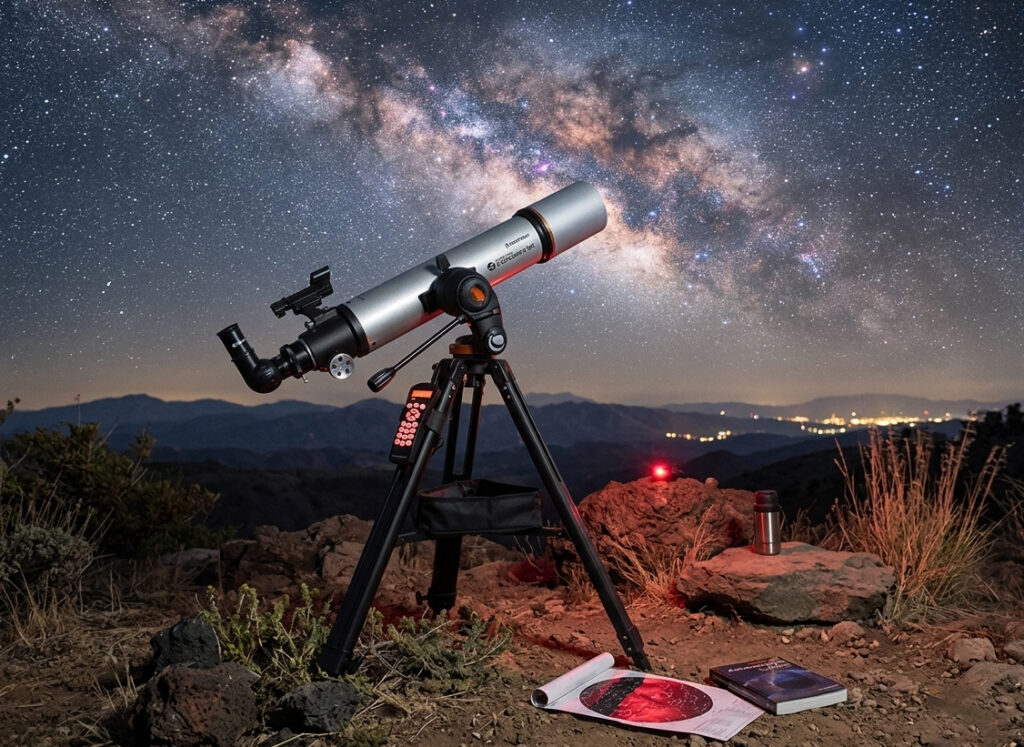
Refractors (Lenses): These use glass lenses to collect light. They are low-maintenance, rugged, and provide high-contrast images. They are excellent for viewing the Moon and planets.
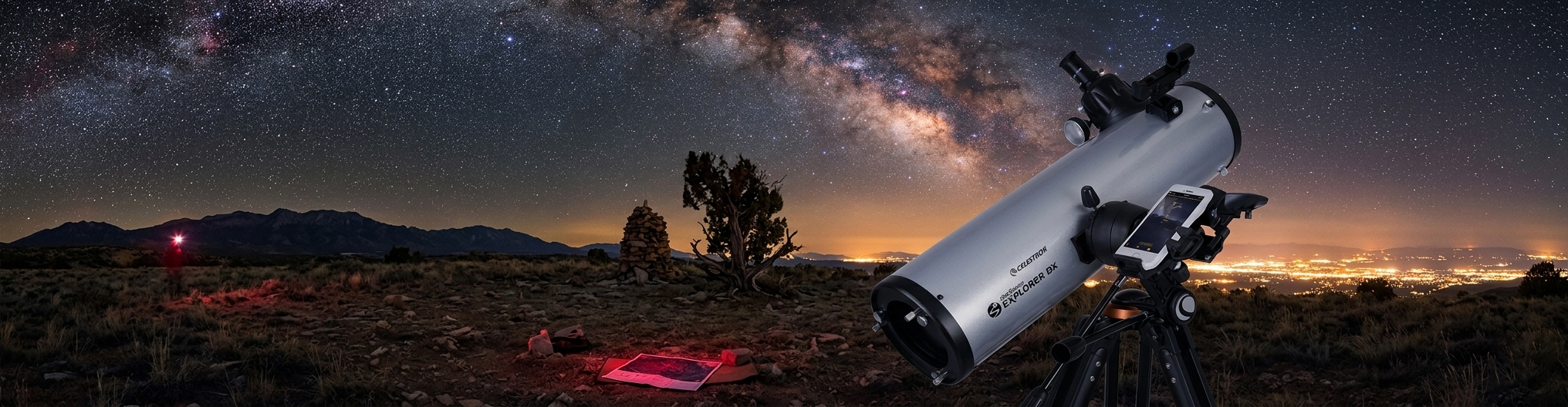
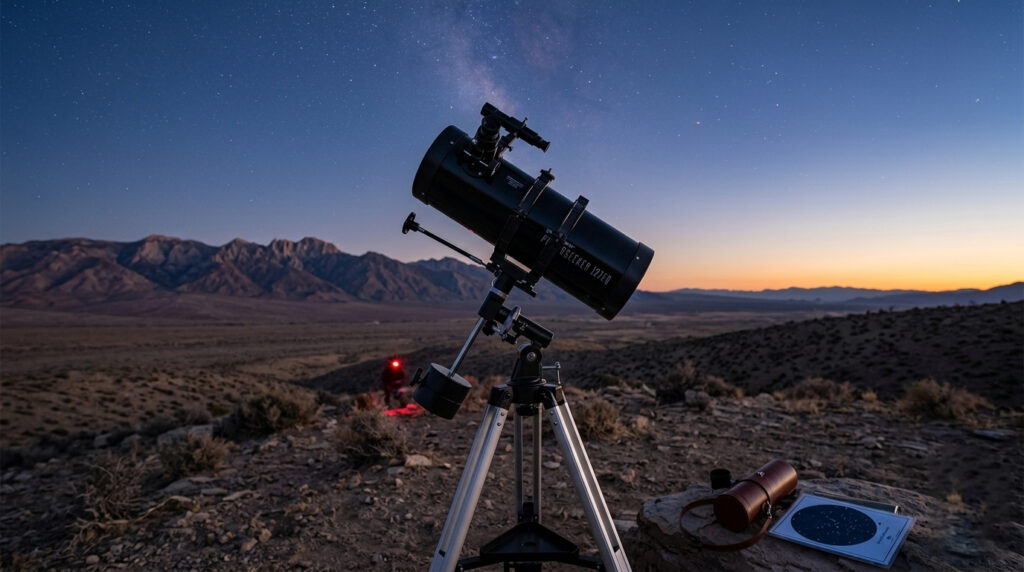
Reflectors (Mirrors): These use mirrors to gather light. Because mirrors are cheaper to produce than large lenses, reflectors offer the most “bang for your buck” in terms of aperture. These are the kings of Deep Sky Objects like galaxies.
Compound (Catadioptric): These use a combination of lenses and mirrors. They are compact and portable, making them great for high-magnification viewing in a small package, though they tend to be more expensive.
2. Aperture: The Most Important Number
In astronomy, aperture (the diameter of the main lens or mirror) is everything. It determines how much light the telescope collects.
70mm to 90mm: Great for the Moon and bright planets.
114mm to 150mm: The “sweet spot” for beginners. You’ll start seeing faint nebulae and star clusters.
200mm+ (8 inches): Serious light-gathering power for deep-space exploration.
Note: Ignore “Magnification” claims on the box. High magnification is useless if the aperture isn’t large enough to provide a clear, bright image.
3. The Mount: Your Foundation
A shaky mount will ruin even the best optics. There are two primary types:
Alt-Azimuth (AZ): Moves up-down and left-right. It’s intuitive and easy to set up—perfect for casual scanning or birdwatching.
Equatorial (EQ): Aligned with the Earth’s axis. It’s more complex to set up but allows you to track a star as it moves across the sky by turning a single slow-motion knob.
4. Portability vs. Power
A massive 10-inch Dobsonian reflector provides incredible views, but it can be heavy and cumbersome. If you have to drive to a dark-sky site to escape city lights, consider a “Grab-and-Go” setup like a tabletop Reflector or a compact Refractor.
5. Summary Checklist
If you want to see…
Choose…
Planets & Moon
A Refractor or a long-focal length Compound.
Galaxies & Nebulae
A large-aperture Reflector (Dobsonian).
Astrophotography
A sturdy Equatorial mount and a specialized Refractor.
Maximum Portability
A Tabletop Reflector or a small Schmidt-Cassegrain.
Exploring the night sky is as much about the gear as it is about the location. For your first outing, try a high-quality pair of 10×50 binoculars alongside your telescope; they are invaluable for learning the constellations before you zoom in.
But I must explain to you how all this mistaken idea of denouncing pleasure and praising pain was born and I will give you a complete account of the system, and expound the actual teachings.
rosetyler
Nor again is there anyone who loves or pursues desires to obtain pain of itself, because it is pain, but because occasionally circumstances occur in which toil and pain.
Ruta Vaghasiya
Many desktop publishing package and web page editor now use as their default model text, and a search for ‘lorem ipsum’ will uncover many web sites.
Ruta Vaghasiya
All the Lorem Ipsum generators on the Internet tend to repeat predefined chunks as necessary, making this the first true generator on the Internet. It uses a dictionary of over 200 Latin words combined.




4 comments
Ruta Vaghasiya
But I must explain to you how all this mistaken idea of denouncing pleasure and praising pain was born and I will give you a complete account of the system, and expound the actual teachings.
rosetyler
Nor again is there anyone who loves or pursues desires to obtain pain of itself, because it is pain, but because occasionally circumstances occur in which toil and pain.
Ruta Vaghasiya
Many desktop publishing package and web page editor now use as their default model text, and a search for ‘lorem ipsum’ will uncover many web sites.
Ruta Vaghasiya
All the Lorem Ipsum generators on the Internet tend to repeat predefined chunks as necessary, making this the first true generator on the Internet. It uses a dictionary of over 200 Latin words combined.